Vanadium is a classic industrial vitamin; it is seldom used on its own and is almost entirely incorporated into steel as an alloy additive, yet it exerts an outsized effect on steel properties. Steel is its largest outlet: adding a few thousandths of vanadium to steel forms fine vanadium carbonitride particles that refine grains and provide precipitation strengthening, greatly raising strength and toughness; high-strength deformed bar, line-pipe steel, rail steel, automotive gear steel and tool steel all depend on vanadium, and a large share of worldwide vanadium consumption goes to rebar and construction steel. In energy storage, all-vanadium flow batteries have been a recent star: vanadium ions are stored in two giant electrolyte tanks, and charging and discharging rely on the change in vanadium valence, offering safety, long life and linearly scalable capacity; they are widely used in grid-scale long-duration energy storage and in peak-shaving support for wind and solar farms. In chemicals and environmental protection, vanadium is the key catalyst in the contact-process oxidation of sulfur dioxide to sulfuric acid, and is also used in certain organic syntheses. Vanadium is irreplaceable in two seemingly unrelated fields—steel and batteries—because its variable valences both produce microscopic precipitation strengthening and enable reversible electrochemical storage.
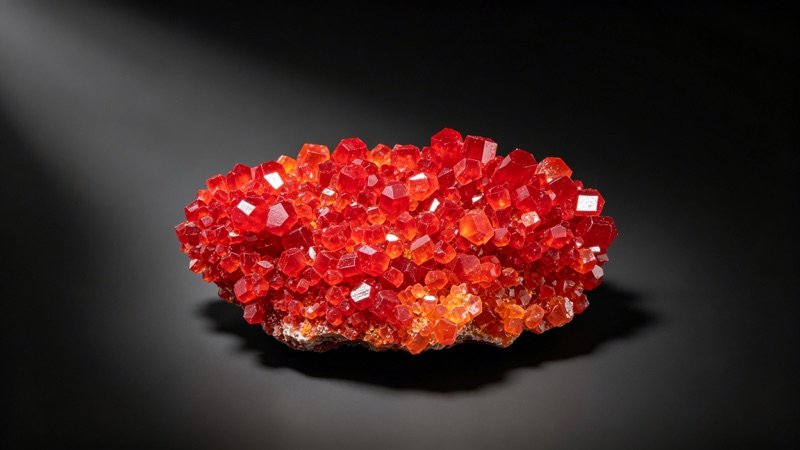
Vanadium pentoxide (V2O5) is the most important vanadium compound, an orange-yellow crystal that is both the main raw material for extracting vanadium metal and ferrovanadium, and the catalyst for SO2 oxidation in contact-process sulfuric acid and petroleum desulfurization, as well as a colorant for ceramics and glass. Vanadium dioxide (VO2) has a unique abrupt phase-transition behavior: when heated it suddenly switches from an insulating to a metallic state, accompanied by an abrupt change in infrared transmittance; it is used in smart energy-saving windows, temperature-controlled infrared-regulating materials and thermal switches. Ammonium metavanadate (NH4VO3) is an intermediate in hydrometallurgical vanadium extraction; after precipitation from solution, it thermally decomposes to vanadium pentoxide, and is also used as a catalyst, mordant and ceramic colorant. Ferrovanadium (FeV) is an alloy of vanadium and iron that is charged directly into furnaces during steelmaking for alloying; it is the main form in which vanadium enters the steel industry and is graded by vanadium content, and is widely used in structural steel, tool steel and rail steel. Beyond all-vanadium flow batteries, vanadium is also added to vanadium-aluminum master alloys and certain titanium alloys, but its combined use in steel and energy storage accounts for the vast majority of its total consumption.