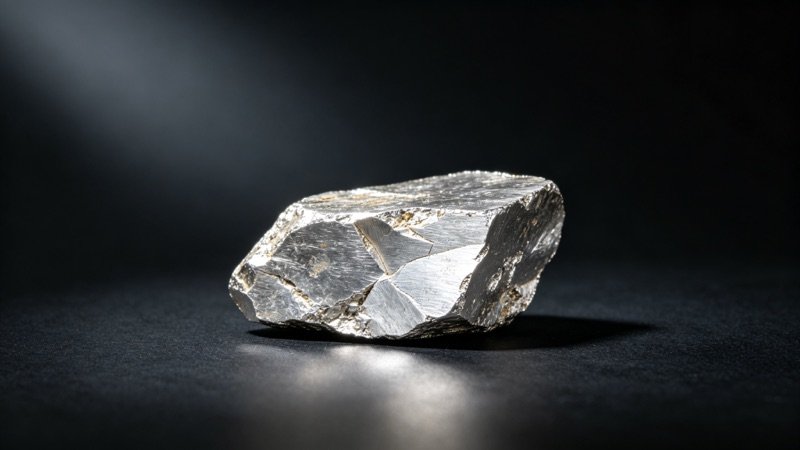
Lanthanum is the first of the lanthanide rare earths and one of the most abundant rare-earth elements in the crust. Because of its chemical reactivity, it almost always does its work as oxides or alloys, and the pure metal rarely appears directly in consumer goods. Its first major modern application is catalysis: lanthanum supported on zeolite (often together with cerium) is a key component of fluid catalytic cracking catalysts, cracking heavy oil into gasoline and diesel fractions and boosting gasoline yield and octane number—among the rare-earth catalysts consumed annually by refineries worldwide, lanthanum and cerium account for the bulk. Its second major application is the hydrogen-storage alloy negative electrode of nickel-metal hydride batteries: AB5-type alloys formed by lanthanide metals with nickel, aluminum, and cobalt—LaNi5 being the most typical—reversibly absorb and release hydrogen at room temperature; the negative electrodes of NiMH batteries in hybrid vehicles, as well as early laptop and power-tool batteries, use this hydrogen-storage alloy. Flint (a cerium-iron mixed rare-earth alloy, often containing lanthanum) is the traditional spark material for lighters and signal fire sources, and remains the main component of disposable lighters and outdoor fire starters. In optical glass, adding lanthanum oxide greatly raises the refractive index, yielding the high-index, low-dispersion lanthanum glass used in camera, phone, and projector lenses. In steel and nonferrous metals, lanthanum as a trace rare-earth additive desulfurizes, deoxidizes, and refines grain size, markedly improving the toughness and corrosion resistance of steels.
Lanthanum oxide (La2O3) is the most basic lanthanum compound, a white powder used to make high-refractive-index, low-dispersion optical glass and lens elements, and as a catalyst promoter and dielectric material in ceramic capacitors; it is also the feedstock for lanthanum metal and lanthanum alloys. Lanthanum hexaboride (LaB6) is a dark-red ceramic crystal with an extremely low work function, making it a high-performance thermionic emission cathode material. It is widely used as the electron-gun filament in scanning electron microscopes, transmission electron microscopes, electron-beam lithography, and electron-beam welding equipment, offering longer life and higher brightness than traditional tungsten filaments. LaNi5, the lanthanum pentanickel intermetallic compound, is a classic room-temperature hydrogen-storage alloy; at ambient temperature it reacts with hydrogen to form LaNi5H6, absorbing about a hundred times its own volume of hydrogen. It is the negative-electrode material of nickel-metal hydride batteries and a model system for early hydrogen-storage research; commercial hydrogen-storage alloys usually partially substitute cerium, neodymium, aluminum, and cobalt for lanthanum and nickel to improve cycle life.