Home/ Elements/ Pm
Promethium
Pm 61

Promethium

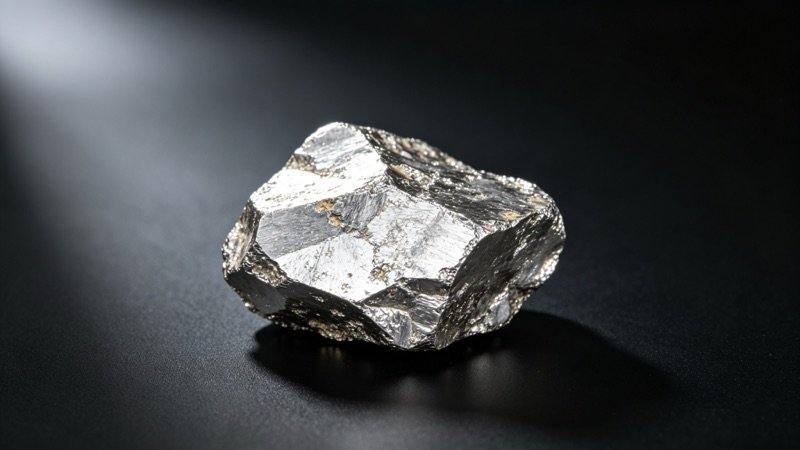
Promethium is a chemical element; it has symbol Pm and atomic number 61. All of its isotopes are radioactive; it is one of only two elements (the other being technetium) that have no stable isotopes and no long-lived primordial radioisotopes. The element was discovered in 1945 by Jacob A. Marinsky, Lawrence E. Glendenin, and Charles D. Coryell as a fission product of uranium. Promethium is used in luminous paint, atomic batteries, and thickness gauges.

Lanthanide metallic
Atomic number 61Z
Atomic mass 145u
Valence e⁻ 2
Electron config. 1s2 2s2 2p6 3s2 3p6 4s2 3d10 4p6 5s2 4d10 5p6 6s2 4f5
Density
7.26g/cm³
Melting point
1042°C
Crustal abundance
4e-07ppm
Annual production
—
Recycling rate
0%(Radioactive lanthanide; no recycling)

Why This Element

Promethium is the rarest naturally occurring element (1 part per quadrillion in Earth's crust) and the only exclusively radioactive lanthanide. Its primary uses leverage its beta decay radiation: luminous paint for watch hands, nuclear batteries providing decades of power without maintenance, and thickness gauges for industrial applications — all at extremely small scales due to rarity.

Applications

Luminous paintNuclear batteries

Applications in DepthElement & compound uses

Main Uses of the Element

Promethium is the only lanthanide with no stable isotopes. It is essentially absent from natural crustal rocks and can only be produced in trace amounts by artificial synthesis in nuclear reactors, so it has no industrial-scale practical use. Historically, its compounds were painted onto luminous dials for night-illuminated instruments and marine beacon lights, but these applications have largely been phased out for radiation-safety reasons. At present, promethium is used only in very small quantities in miniature radioisotope batteries and in nuclear-physics research.

Key Compounds and Their Uses

Compounds of promethium, such as Pm2O3 (promethium(III) oxide) and PmCl3 (promethium trichloride), are prepared only in trace amounts in laboratories and as irradiated targets, used for materials irradiation studies and radioactive tracing; they do not enter any consumer product, and no large-scale industrial production exists.

Element History

Promethium is the only radioactive lanthanide. First detected in 1945 by Jacob A. Marinsky, Lawrence E. Glendenin, and Charles D. Coryell during analysis of fission products from uranium-235 bombardment — making it the last element discovered in the periodic table's main groups. Named for Prometheus by Glendenin's wife Grace. No stable isotopes exist; Pm-145 has a 17.7 year half-life.

Related Elements

La · Lanthanum Ce · Cerium Pr · Praseodymium Nd · Neodymium Sm · Samarium Eu · Europium Gd · Gadolinium Tb · Terbium

Frequently Asked QuestionsLong-tail Q&A · data-driven

What is the melting point of Promethium?
1042 °C
What is the boiling point of Promethium?
3000 °C
What is the density of Promethium?
7.26 g/cm³
What are the atomic number and category of Promethium?
61 · Lanthanide
Which ore is Promethium mainly extracted from?
None (synthetic)
What are the main uses of Promethium?
Promethium is the rarest naturally occurring element (1 part per quadrillion in Earth's crust) and the only exclusively radioactive lanthanide. Its primary uses leverage its beta decay radiation: luminous paint for watch
Who discovered Promethium and when?
Chien Shiung Wu · 1945