Home/ Elements/ Cm
Curium
Cm 96

Curium

Curium is a chemical element; it has symbol Cm and atomic number 96. This transuranic actinide element was first produced and identified in 1944 by Glenn T. Seaborg, Ralph A. James, and Albert Ghiorso by bombarding plutonium-239 with helium ions. Curium was named in honor of Marie and Pierre Curie. Curium-242 and curium-244 have been used as alpha particle sources and in radioisotope thermoelectric generators for spacecraft, though less frequently than plutonium-238.

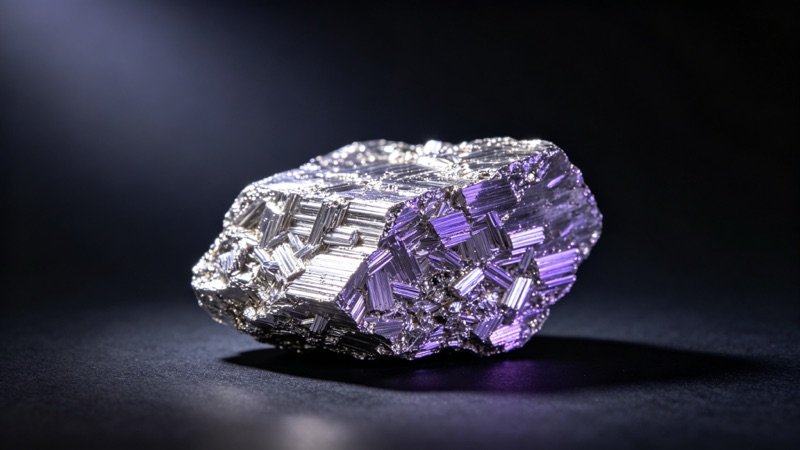
Actinide silvery metallic, glows purpl...
Atomic number 96Z
Atomic mass 247u
Valence e⁻ 2
Electron config. 1s2 2s2 2p6 3s2 3p6 4s2 3d10 4p6 5s2 4d10 5p6 6s2 4f14 5d10 6p6 7s2 5f7 6d1
Density
13.51g/cm³
Melting point
1340°C
Crustal abundance
7e-16ppm
Annual production
—
Recycling rate
0%(Radioactive element; no established recycling)

Why This Element

Curium is a high-energy alpha emitter with one of the highest specific activities of any element (Cm-242 produces 3.9 W/g) — yet its short half-life makes it impractical for long-duration applications. It served as the alpha source in early heart pacemakers before being replaced by Pu-238.

Applications

Space power

Applications in DepthElement & compound uses

Main Uses of the Element

Curium is a transuranium element produced artificially by irradiating plutonium or americium in reactors; it does not occur in nature, and world production amounts to only a few milligrams per year. Curium-244 and curium-242, with their relatively high decay heat and convenient half-lives, were once fabricated into small radioisotope power sources used for auxiliary power and instrument heating on some early U.S. deep-space probes, serving as early experimental RTG materials; modern deep-space power supplies have almost entirely switched to plutonium-238. Apart from this, curium is used only in nuclear chemistry and superheavy-element synthesis research and has no consumer or industrial product.

Key Compounds and Their Uses

Curium compounds such as curium dioxide (CmO2) and curium trichloride (CmCl3) are prepared only in microgram-to-milligram quantities in radiochemical laboratories, where they are used in separation flowsheets and spectroscopic studies; they have never entered consumer products.

Element History

Discovered in 1944 by Glenn Seaborg's team during neutron irradiation of Pu-239 — Cm-242 and Cm-244 were the first isotopes identified. Isolated as pure metal in 1945. Curium-242 (163-day half-life) and Cm-244 (18.1-year half-life) are the dominant produced isotopes.

Related Elements

Ac · Actinium Th · Thorium Pa · Protactinium U · Uranium Np · Neptunium Pu · Plutonium Am · Americium Bk · Berkelium

Frequently Asked QuestionsLong-tail Q&A · data-driven

What is the melting point of Curium?
1340 °C
What is the boiling point of Curium?
3110 °C
What is the density of Curium?
13.51 g/cm³
What are the atomic number and category of Curium?
96 · Actinide
Which ore is Curium mainly extracted from?
Nuclear reactor (synthetic)
What are the main uses of Curium?
Curium is a high-energy alpha emitter with one of the highest specific activities of any element (Cm-242 produces 3.9 W/g) — yet its short half-life makes it impractical for long-duration applications. It served as the a
Who discovered Curium and when?
Glenn T. Seaborg · 1944